Insights into the Polymarket ecosystem.
Guides and deep-dives on streaming Polymarket data, building trading bots, and getting an edge before the chain settles.
3.1 million traders — and the $48M they forgot: a Polymarket wallet census
A census of Polymarket's 3.09M traders: 350× growth in three years — and $48.4M sitting in trading wallets that have been silent for over three months.
Read →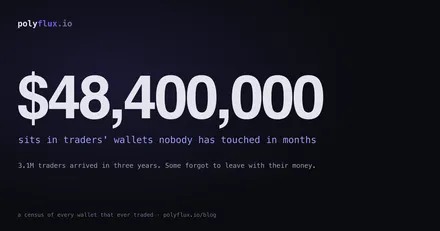
Polymarket in 2026: $26.8B traded, one war arc, and 3.5% of wallets doing 88% of it
Polymarket traded $26.8B in the first 218 days of 2026. Daily volume, what drove every peak, the category rotation, and the 3.5% of wallets behind 88% of fills.
Read →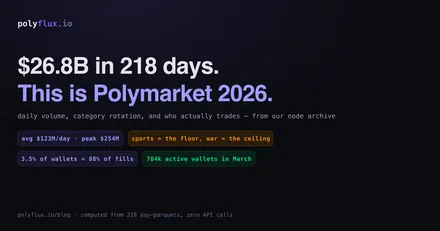
Polymarket arbitrage, honestly: the three real kinds and why bots win them
The three real kinds of Polymarket arbitrage — YES+NO mispricing, negative-risk sets, cross-platform spreads — what they pay, and why bots win them.
Read →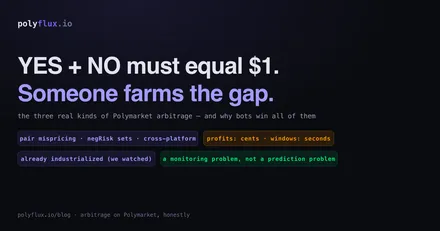
Copy-trading Polymarket whales: the complete guide
How to copy-trade Polymarket whales: find wallets worth following, vet their history, see their trades seconds early, and know when not to follow.
Read →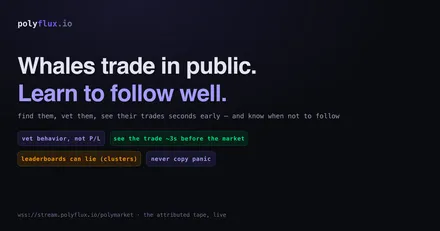
Real-time Polymarket data: official websockets vs. subgraphs vs. node streams
Polymarket's own websockets are real-time but partial. Subgraphs have the data but index late. Node streams are fast but costly. A comparison.
Read →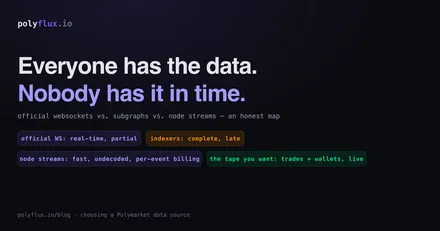
Unlike traditional finance, Polymarket gives you wallet-level order flow
On Wall Street, who traded is a secret or a quarterly filing. On Polymarket every fill has a wallet attached — if you connect the right way. A comparison.
Read →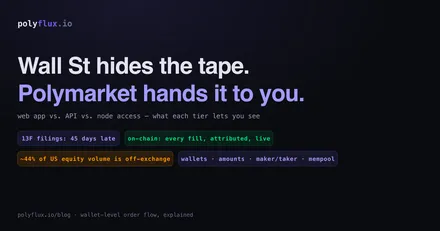
The trading strategy that benefits from panic sellers: concept and execution
When someone market-sells a big Polymarket position into a thin book, the discount goes to whoever had resting bids. Here is how that strategy works.
Read →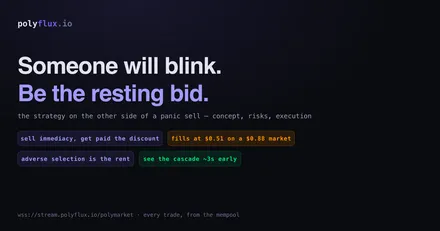
A couple of panic decisions, $62K gone — others were waiting for him to blink
One Polymarket wallet built 'no war' positions for four months and panic-sold them three times. The order book charged ~$62K for the urgency.
Read →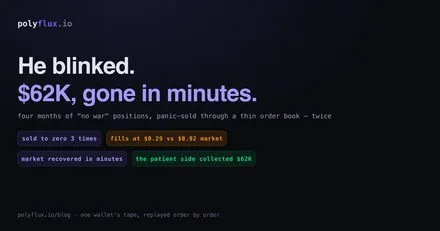
How Polymarket markets resolve: UMA, proposals, disputes, and the $750 at stake
Polymarket outcomes are decided by UMA's Optimistic Oracle: a $750 bond, a 2-hour challenge window, and — if disputed — a 2–4 day tokenholder vote.
Read →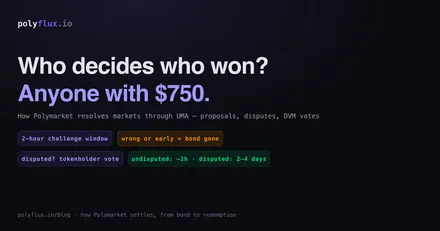
Thirty days of Polymarket deposits: $49 medians, $783K whales, and one wallet that tops up every 9 minutes
We classified a month of on-chain deposits into Polymarket accounts: 29,368 deposits, $38M+, and a handful of wallets whose funding patterns tell stories.
Read →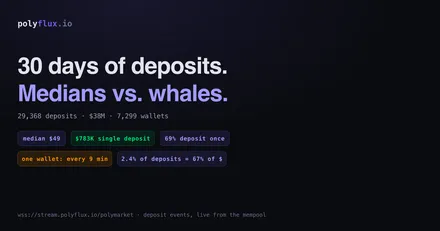
Following the money: one day of Polymarket peer-to-peer transfers
On July 28, 2026, $606K moved directly between Polymarket wallets in 10,335 transfers. We mapped every flow — and the wallets cluster into clear hub-and-spoke shapes around a handful of high-volume traders.
Read →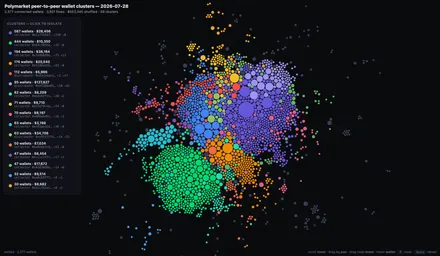
Polyflux vs. running your own Polygon node for Polymarket data
DIY Polymarket data means terabyte disks, mempool peering, protocol decoding, and a maintenance treadmill of hardforks. Here's the honest build-vs-buy math.
Read →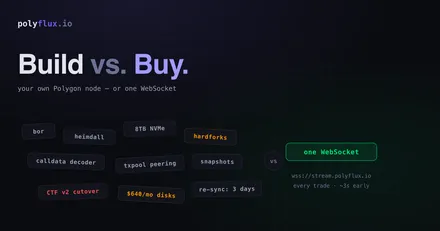
Polymarket trading strategies: six classics and the data they run on
Copy trading, momentum, arbitrage, market making, mean reversion, news trading — how each classic strategy works on Polymarket and the data it needs.
Read →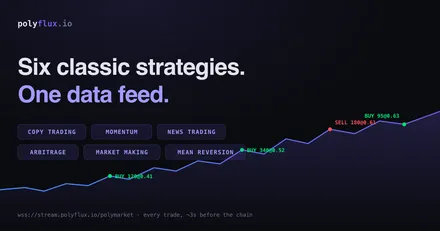
Inspect wallet behavior: reading the story in Polymarket trade history
A wallet's trade history tells a story — entries, exits, discipline. Here's how to collect Polymarket trades per wallet and read behavior, not just P/L.
Read →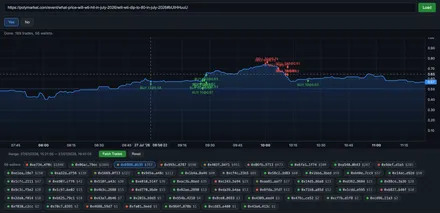
polyflux-client: stream Polymarket trades in Python and name every market
The official Polyflux Python library: typed real-time trades with auto-reconnect, plus a MarketCatalog that resolves any asset_id to its market in O(1).
Read →How trade streaming beats the public Polymarket API for tracking wallets
Polling Polymarket's API for wallet positions lags 3–120 seconds. Streaming trades and applying them locally keeps positions current in real time.
Read →Why the order book WebSocket isn't enough for effective Polymarket trading
Polymarket's API streams live order book updates — but book deltas can't tell you if a trade happened or an LP moved. Here's what the book hides.
Read →Polymarket wallet types explained: EOA vs Magic vs Gnosis Safe
Polymarket has three account types — EOA, Magic (email) proxy, and Gnosis Safe proxy. Here's how each works and which signature_type your bot needs.
Read →Your first Polymarket trading bot: from account to copying a whale
Set up a Polymarket account, export your Magic wallet key, and build a primitive Python bot that watches the live feed and copies a whale's trades.
Read →How to stream live Polymarket trades in Python
Connect to the Polymarket mempool feed and read every trade the millisecond it happens — with the polyflux-client library or a raw WebSocket.
Read →Manual vs. automated Polymarket trading: which is right for you?
Manual trading means you watch and click; automated trading means a bot reacts for you in milliseconds, 24/7. Here's the real difference and when each wins.
Read →What is the Polymarket mempool, and why does it matter?
The Polymarket mempool is where trades wait before confirming on-chain. Seeing it live gives traders a ~3-second head start. Here's how it works.
Read →What is Polymarket? How it works and the tech behind it
Polymarket is an on-chain prediction market where you trade shares in real-world outcomes. Here's how it works — the order book, USDC, and Polygon settlement.
Read →