In traditional markets, you never learn who is behind a trade. On Polymarket, you can — every fill settles on a public blockchain with both wallets attached. The information is there for everyone; the practical question is how much of it your connection method actually exposes. This post compares the three ways to plug into Polymarket — the web app, the API, and blockchain-level access — and what each one lets you see.
What Wall Street shows you: price, size, and silence
Start with the baseline this is “unlike.” In US equities, the public tape tells you a trade’s price and size — never who made it. Identity-level information surfaces in exactly two ways, both bad:
- Late and partial. Institutions managing over $100M disclose holdings in quarterly 13F filings — up to 45 days after the quarter ends, long positions only, with confidential-treatment exemptions on top. By the time you read it, the position is months old.
- Private and sold. Roughly 44% of US equity volume executes off-exchange — in dark pools and wholesaler internalization. Retail order flow is routed to firms like Citadel Securities under payment-for-order-flow arrangements; by the SEC’s own estimate, 90–95% of retail orders never reach a lit exchange. The people who do see attributed flow paid for the privilege — and it isn’t you.
Order-flow attribution — who is accumulating, who is exiting, who is on the other side of your fill — is arguably the most valuable dataset in trading. In traditional finance it is structurally reserved for intermediaries. On a blockchain-settled market, it is a public good.
Three ways to connect, three levels of sight
Every Polymarket trade ultimately settles on Polygon, so the full data exists for all of them. What differs is how much each access method surfaces:
| Manual trading | API trading | API + node access | |
|---|---|---|---|
| Basic trading (buy, sell, split, merge, convert) | full | full | full |
| Top holders / positions | partial | partial | full |
| Wallet-level trade flow (wallets, amounts, maker/taker, counterparties) | none | partial | full |
| Pending transactions (mempool) | none | none | full |
Basic trading: everyone gets this
No matter how you trade — clicking in the app or signing orders through the CLOB API — the full set of trading operations is available: buy, sell, and the split/merge/convert mechanics underneath them. Access tiers don’t gate doing; they gate seeing.
Top holders and positions: the visible surface
The web interface shows you a market’s leaderboard — top YES and NO holders with share counts:
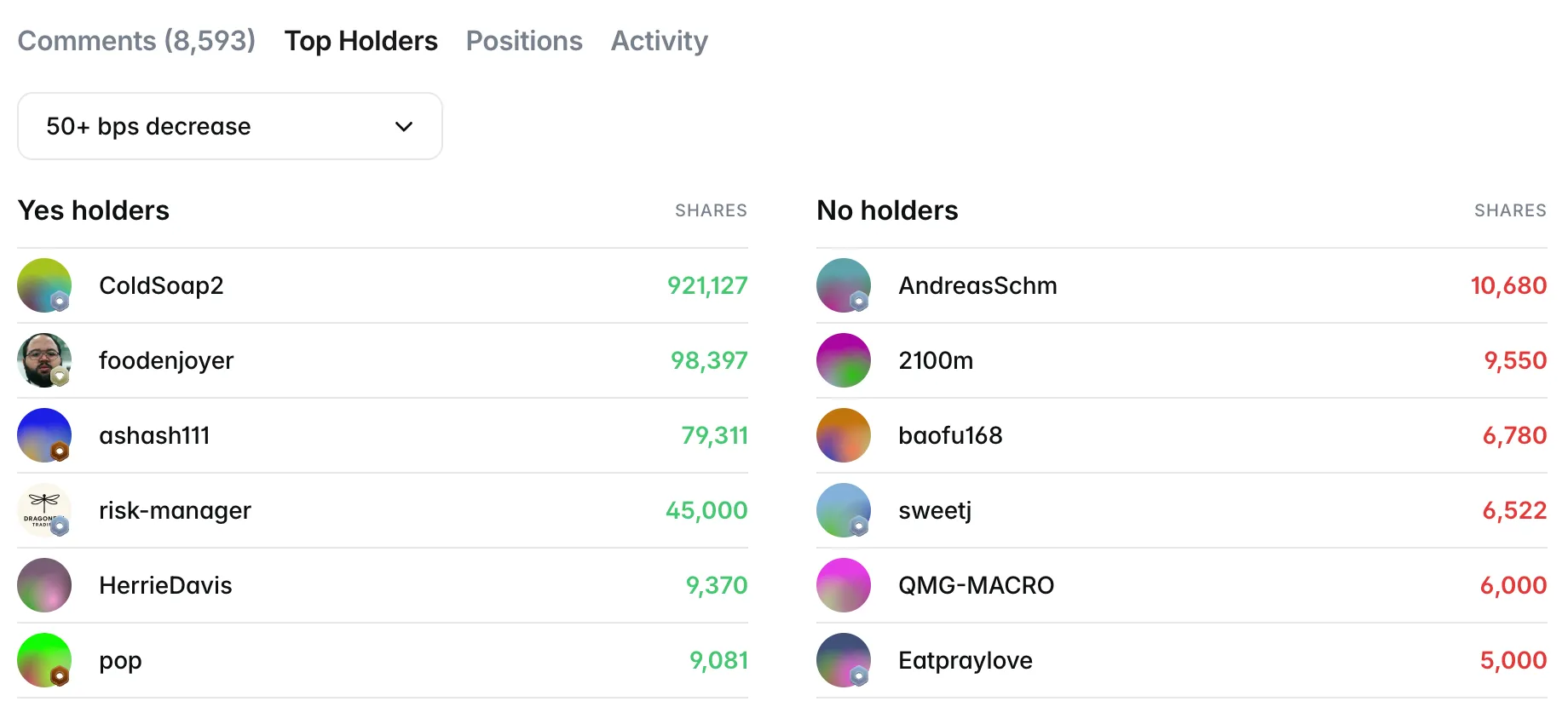
The public API returns the same holders and positions programmatically, plus any wallet’s trade history if you ask wallet by wallet. This is genuinely useful — we built a whole wallet-reading guide on it. But it is a snapshot view: you see standings, not flow. Who is currently big, not who is getting bigger right now, or who they’re buying from.
Wallet-level trade flow: the full tape
On-chain, every fill is a settlement event that names both sides. One trade gives you: the maker’s wallet, the taker’s wallet, the amounts and price, and which side was which. Multiply by every trade on the platform and you have something that does not exist in traditional markets at any price: a complete, attributed, real-time tape.
That dataset is what our recent case studies are made of. Watching one wallet panic-sell its way to a $62K loss — and identifying the buyers who caught the shares — is wallet-level flow. Watching Gohst’s resting bids collect fills at prices that never appear on a chart is wallet-level flow. Copy-trading a specific sharp, mapping clusters of related accounts, or measuring which wallets get funded before they strike — all of it starts with knowing who, on every trade.
Pending transactions: the mempool tier
The deepest level is seeing trades before they confirm — while they sit in the mempool, seconds before becoming a block. This is the tier that matters for latency-sensitive uses: copy-trading (enter alongside a tracked wallet instead of after it), real-time signals, and alerting on large flow the moment it is in flight. One honest caveat we’ve written about before: for accounting — tracking exact balances and positions — confirmed data is what counts, since a pending transaction can still fail. The mempool tier is for reacting, not bookkeeping.
Which strategies need which tier
- Discretionary trading — the web app is enough. You trade the market, not the flow.
- Price-based bots (spread, momentum, strategy backtests) — API tier: order books and prices, no attribution needed.
- Flow-based strategies — copy-trading, whale tracking, counterparty-aware liquidity providing, wallet clustering: these only exist at the wallet-level tier. Anonymous data cannot power them, which is exactly why their traditional-finance equivalents are an intermediary privilege.
Getting the full tier the hard way means running your own Polygon node and decoding Polymarket’s contracts — real infrastructure, real maintenance. The managed way is the Polyflux stream: every trade on the platform, from the mempool, over one WebSocket — wallets, amounts, prices, and maker/taker roles already decoded, in a few lines of Python. A 24-hour trial is enough to watch the full attributed tape flow past — and once you’ve seen markets with the who attached, the anonymous kind feels like trading blindfolded.