Everyone watching Polymarket watches trades — who bought what, at what price, in which market. It’s the obvious signal, and it’s the one every data tool surfaces.
But trades aren’t the only thing moving on-chain. Underneath the order book there’s a quieter layer: money moving directly between wallets — no bet, no market, just a transfer from one account to another. Most people never see it, because it doesn’t appear in any trade feed.
We captured a full day of it. Here’s every confirmed peer-to-peer transfer on Polymarket for 2026-07-28 (UTC) — and the surprisingly clean structure hiding inside it.
The numbers
The 10,335 peer-to-peer transfers of that day, in four facts:
- $606,345 moved between 2,599 distinct wallets (1,926 senders, 984 recipients).
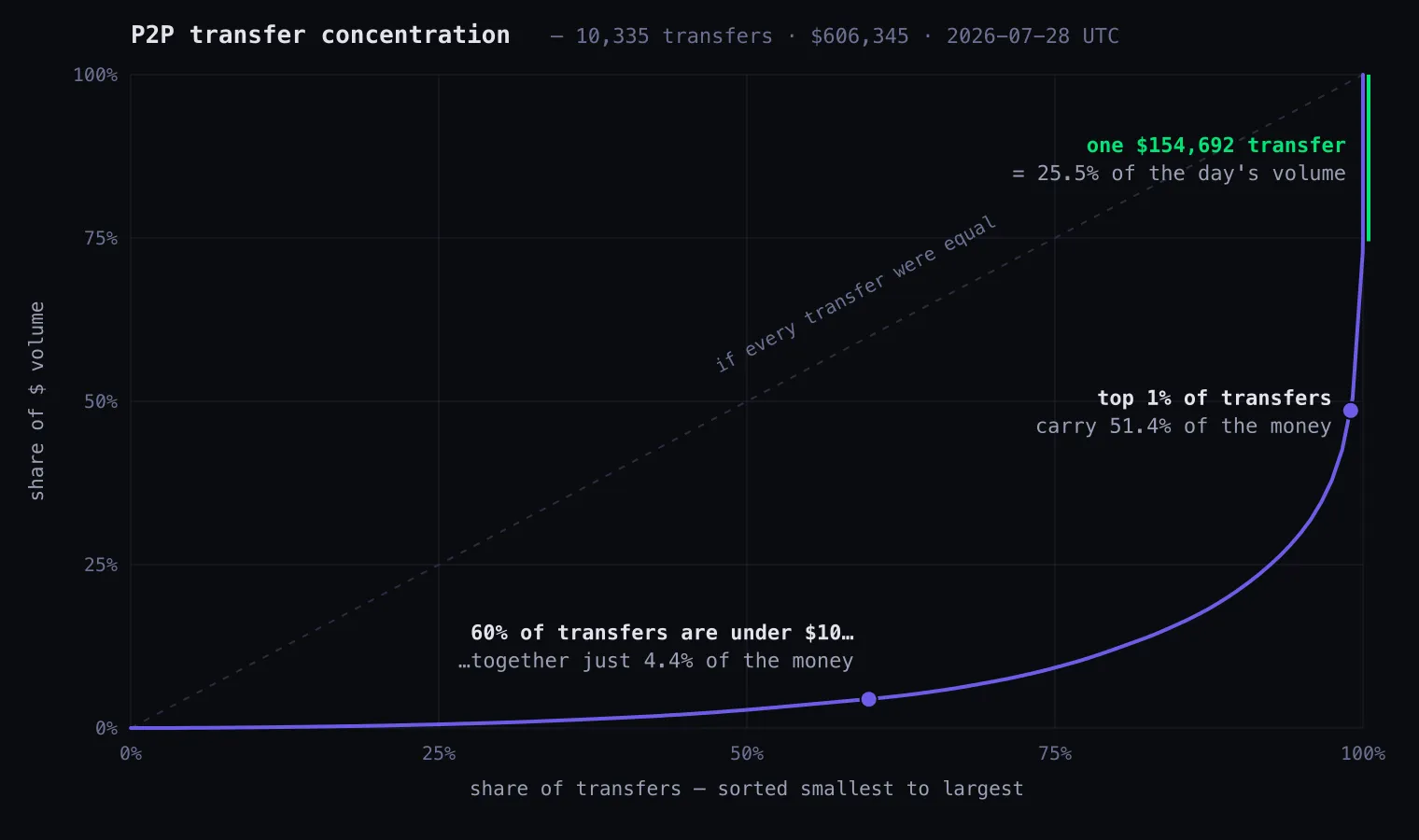
- The typical transfer is tiny: the median is $8.98, and 60% of all transfers are under $10.
- Yet the money is top-heavy. A single transfer of $154,692 was 25.5% of the entire day’s p2p volume — one flow, a quarter of everything.
- The direction is lopsided: 1,615 wallets only ever send, 673 only ever receive, and only 311 do both. Across the whole day, just 40 wallet pairs transferred money in both directions.
The count and the money live at opposite ends of the distribution. Sort all 10,335 transfers from smallest to largest and plot the running share of volume, and the curve barely leaves the floor until the very end: the bottom 60% of transfers add up to 4.4% of the money, while the top 1% carry 51.4% of it.
That last point matters. This isn’t a web of people trading favors back and forth. It’s overwhelmingly one-way — money funneling into certain wallets, or fanning out from others.
The shape of the money
Plot every transfer as a network — wallets are dots, transfers are lines — and the one-way structure becomes visual. 91% of the transacting wallets (2,377 of them) fall into a single connected component, which then breaks cleanly into ~49 clusters (Louvain community detection, modularity 0.83 — a very high score that means the clustering is real, not an artifact of the layout).
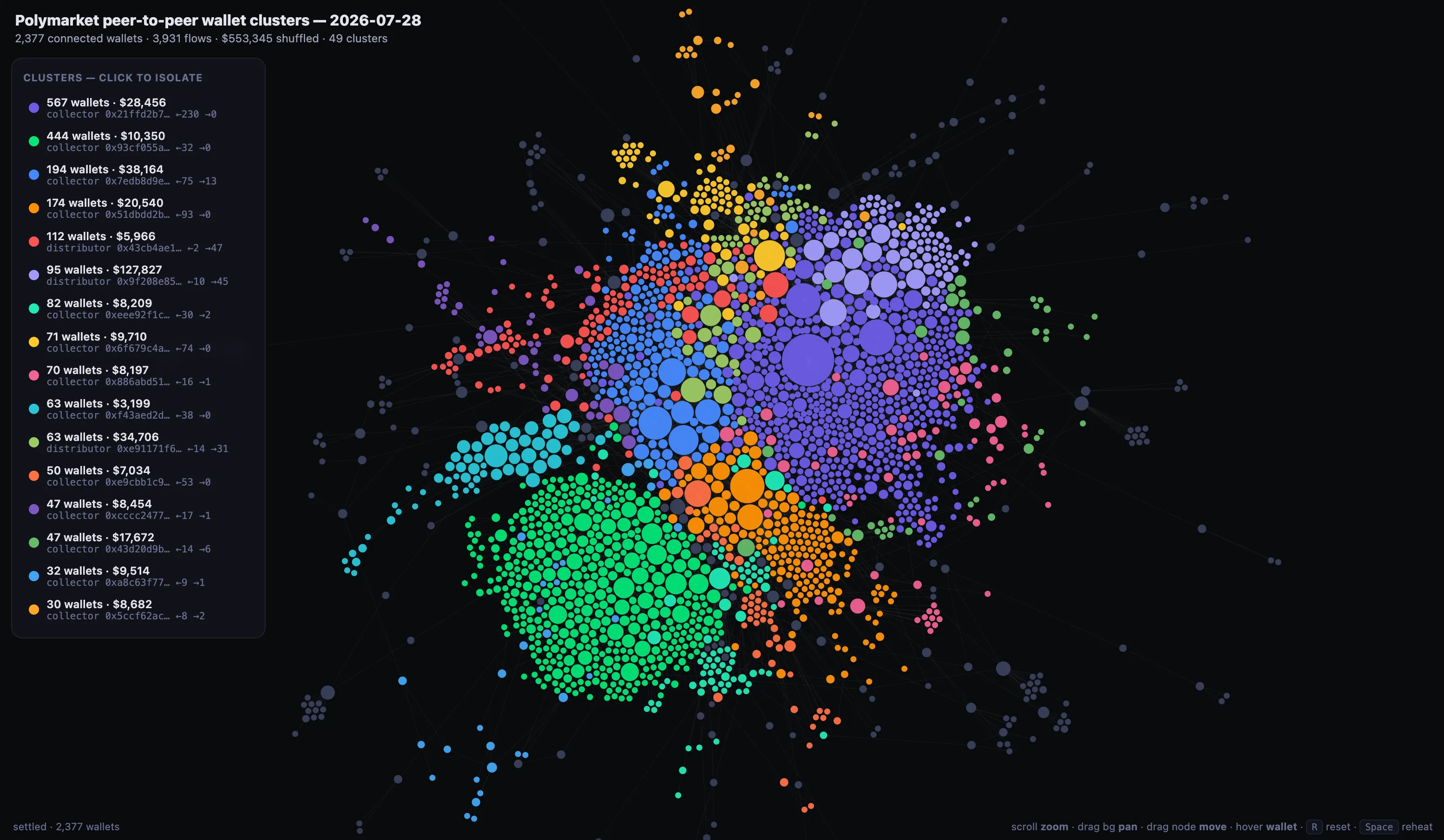
Almost every cluster is the same shape: one hub, many spokes. A central wallet that either collects from dozens or hundreds of others, or distributes to them. The biggest cluster by wallet count is a collector that received from 230 separate wallets and sent to none. The biggest by money is a distributor that pushed $127K out to 45 wallets.
Thirty-eight wallets act as hubs (20+ counterparties each). Everything else is a spoke.
Three clusters, three stories
The hubs aren’t anonymous shells — each is a real, hyperactive Polymarket trader. Cross-referencing the three biggest hubs against their public Polymarket profiles tells three different stories.
1. The collector — 567 wallets flow in
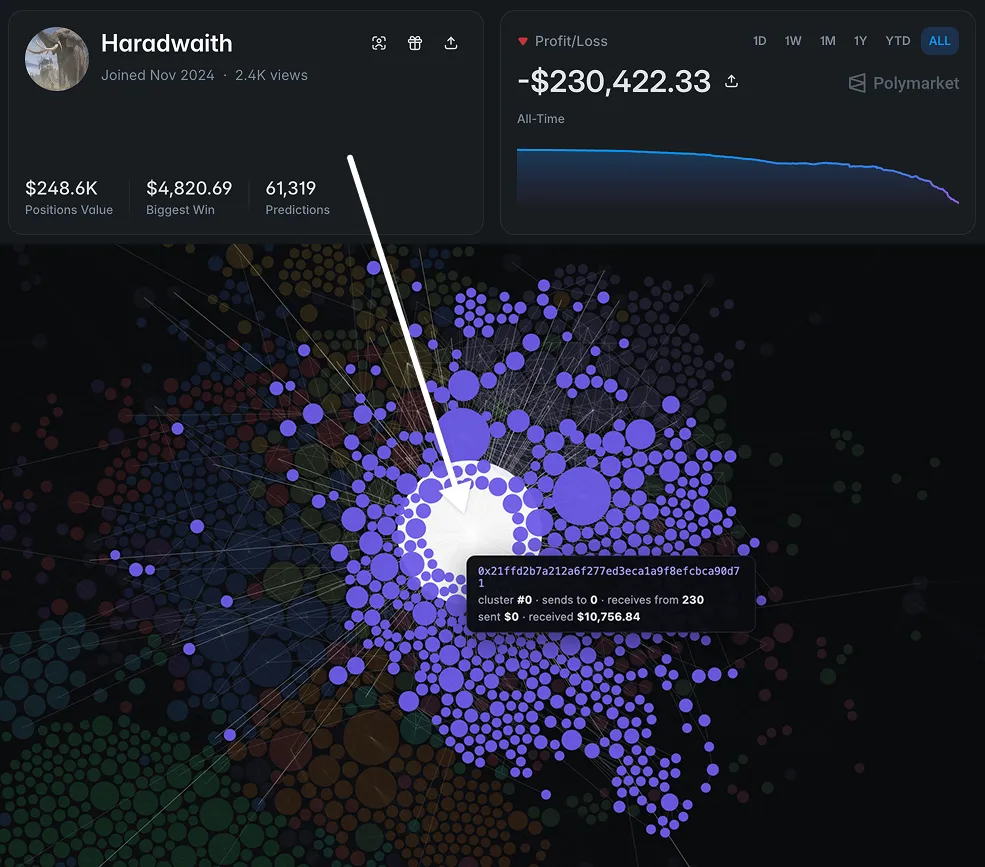
The largest cluster centers on 0x21ff…90d7 (“Haradwaith”) — an account with 61,319 predictions and an all-time P/L of −$230,422. It receives from 230 wallets and sends to zero. Hundreds of small transfers stream in toward a single, hyperactive, deeply-underwater trading account. Capital keeps arriving even as the account bleeds — the kind of pattern you’d expect from bankroll consolidation (many funding wallets topping up one trading wallet) or tips flowing to a well-known name.
2. The distributor — money fans out
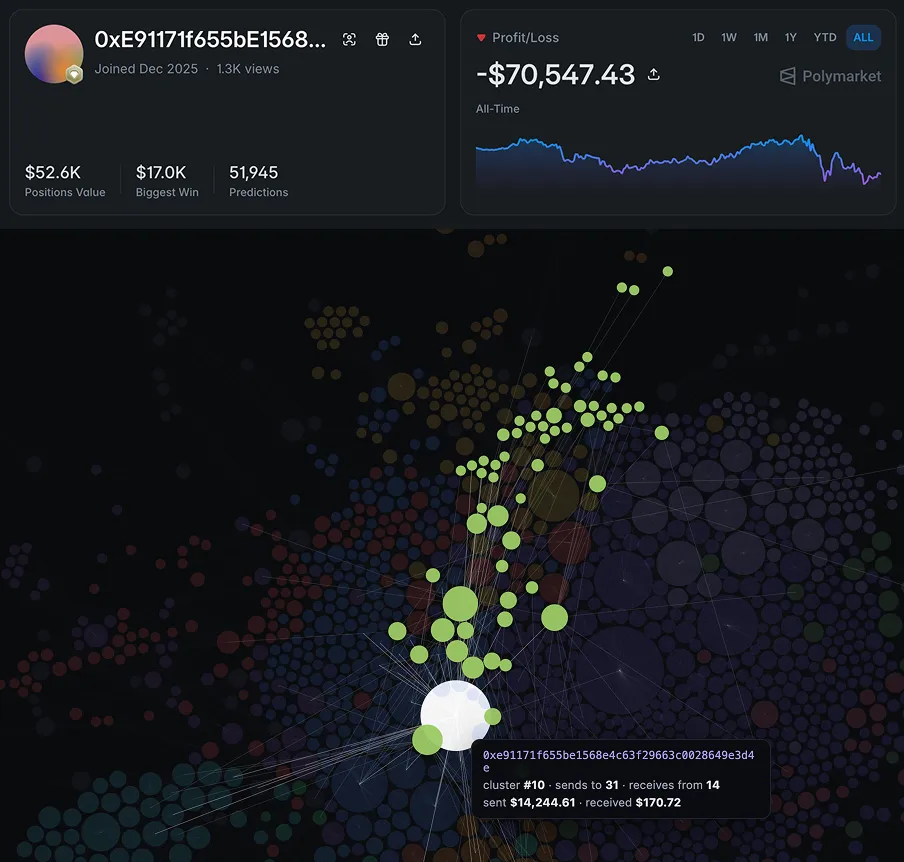
Cluster #10 is the mirror image. Its hub 0xe911…3d4e (51,945 predictions, −$70,547 all-time) sent $14,245 out to 31 wallets while receiving almost nothing back ($171). This is the fan-out shape — one wallet seeding or paying many — consistent with distributing funds to sub-accounts, settling with a group, or paying out.
3. The two-way hub — and it’s the profitable one
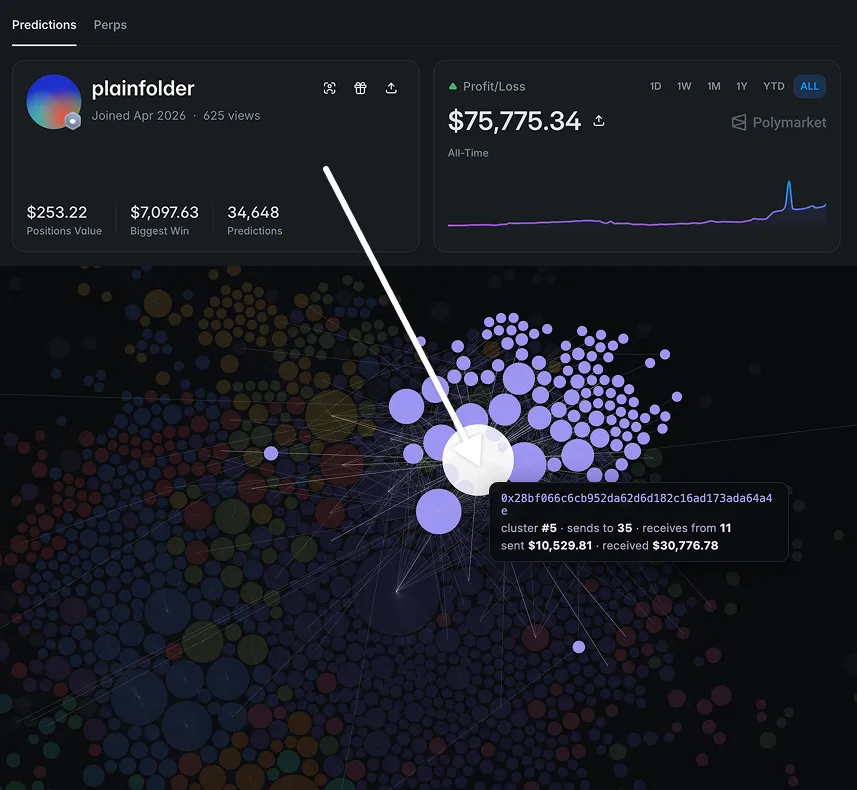
The exception is 0x28bf…64a4e (“plainfolder”) — 34,648 predictions and, unlike the other two, +$75,775 all-time. It both sends to 35 wallets and receives from 11, net-receiving $30,777 against $10,530 sent. A genuinely two-directional hub, and the only winner of the three.
The through-line: all three are extreme high-frequency traders sitting at the center of a wallet cluster. In a pure trade feed they’re just three busy accounts. The transfer layer reveals that each one anchors a network of wallets — relationships you simply can’t see from trades.
A caveat worth stating plainly: on-chain data shows us structure, not intent. A collector hub is consistent with bankroll management, tipping, multi-accounting, or cash routing — the shape is unambiguous, the motive is not. We’re mapping the flows, not accusing anyone of anything.
How these transfers actually happen
There are two ways money moves between Polymarket wallets, and they explain the two halves of the data.
1. The easy way — “Send tip.” Every Polymarket profile has a gift button that opens this:
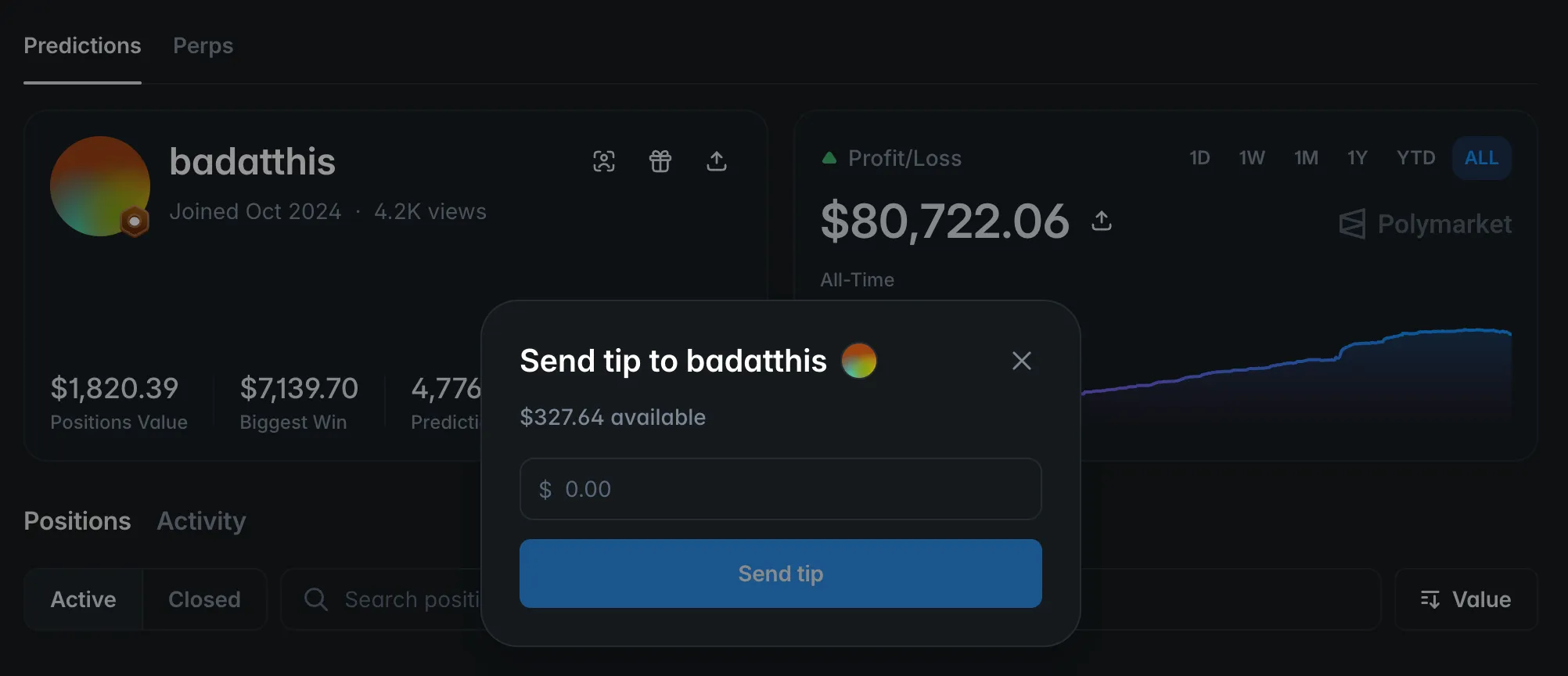
Pick an amount, hit Send tip, done. It moves part of your balance straight to another user. This is almost certainly what generates the flood of sub-$10 transfers — 60% of the day’s count — small amounts sent to popular or admired accounts with a couple of clicks.
2. The technical way — a raw on-chain transfer. Because a Polymarket balance is just pUSD (an ERC-20 token) held in a proxy wallet, anyone can move funds with a direct on-chain transfer — no interface required, scriptable, and unbounded in size. This is how the whales move: the single $154,692 transfer, the distributor fanning tens of thousands of dollars to dozens of wallets, the automated bankroll routing.
Both paths produce the exact same thing on-chain: a p2p_transfer event. Whether it came from a tip button or a signed transaction, it lands in the same stream.
Why this is in the Polyflux feed
Here’s the point most data tools miss: trades are not the whole story. Deposits and peer-to-peer transfers are a parallel signal — who’s funding whom, which accounts money concentrates around, when capital enters and how it moves once it’s inside.
Polyflux streams all of it. deposit and p2p_transfer are first-class event types, delivered over the same WebSocket as trades, in real time from the Polygon mempool. You don’t run a node, you don’t decode raw calldata, you don’t reconstruct proxy-wallet semantics — you connect and read structured transfer events with from, to, amount, and token already parsed.
Everything in this post came from one day of that feed. The wallet-cluster map, the collector and distributor hubs, the tip-sized long tail and the six-figure whale — all of it is sitting in the stream alongside every trade, waiting to be read.
If the money between wallets is a signal you want, grab a key and point the client at the transfer events. The trades tell you what people are betting. The transfers tell you who’s behind them.