Over the last 30 days, 29,368 direct deposits moved $38.4M into 7,299 Polymarket accounts — and the distribution is a barbell: the median deposit is $48.68, while the 2.3% of deposits above $10,000 carry two-thirds of all the money. In between are some genuinely strange wallets: one gets topped up every nine minutes around the clock, and the month’s single biggest deposit — $783,043 — belongs to one of Polymarket’s best-known profiles.
Here’s that barbell — the same month of deposits sliced two ways, by how many and by how much money:
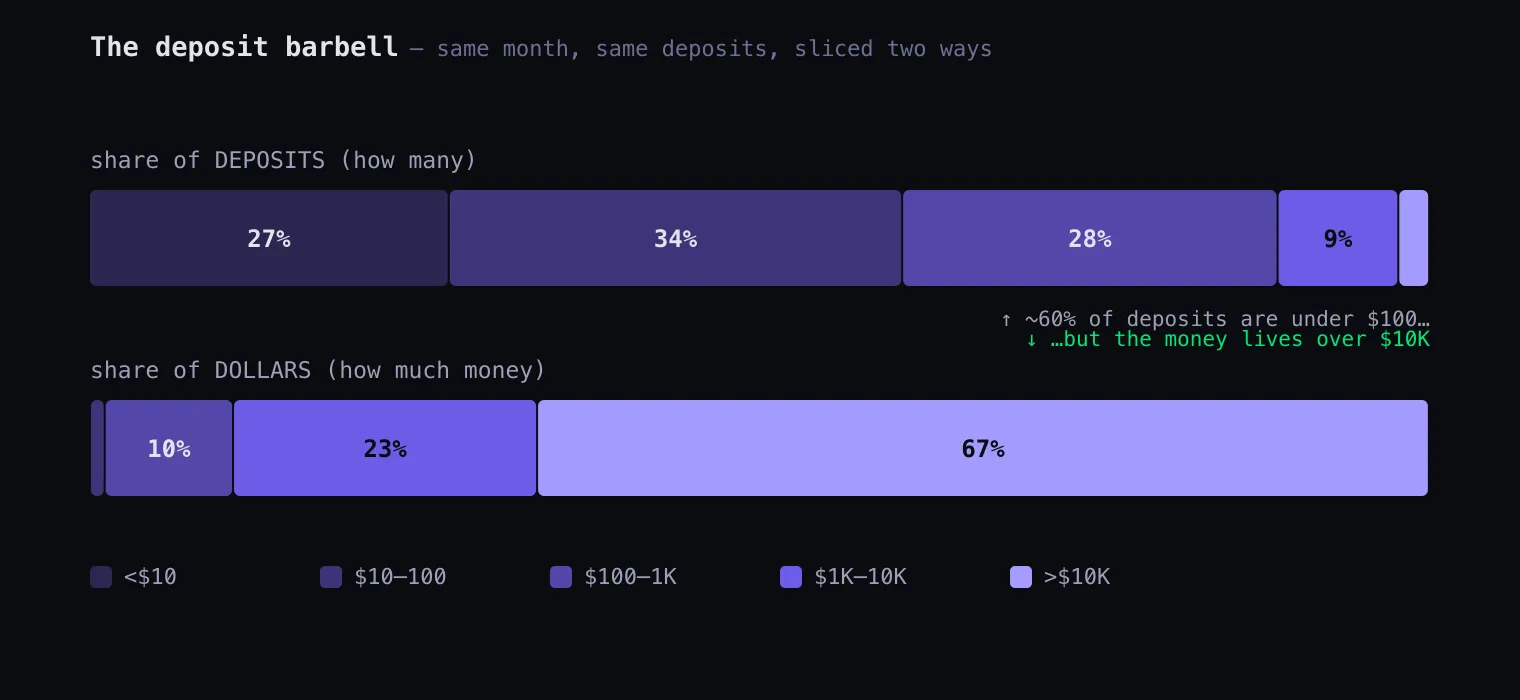
The top strip is crowds: most deposits sit in the small buckets. The bottom strip is money: it lives almost entirely in the big ones. The mismatch between the two strips is the story of who funds Polymarket.
This is the second dispatch from our on-chain money-flow series — the first mapped a day of peer-to-peer transfers between wallets. This time: the money coming in.
A note on method, because it matters: we classify deposits conservatively. A transfer counts only when external stablecoins arrive at a wallet our registry confirms is a Polymarket funder account, from a source that is neither Polymarket-internal nor protocol plumbing. Ambiguous flows are dropped, not guessed at (we’ve written about why that discipline matters). So treat every number here as a floor, not a census — the clean slice, fully attributable.
The shape of a month of funding
- ~979 deposits a day, about $1.28M/day, into ~243 distinct wallets daily.
- The median deposit is $48.68. 59.5% of deposits are under $100 — and together those thousands of small top-ups are just 1.1% of the volume.
- The barbell’s other end: deposits over $10K are 2.3% of the count and 66.8% of the money.
- And the rails are old: $33.2M arrived as bridged USDC.e, versus $5.1M native USDC and a negligible $0.1M USDT. The legacy token still carries the money.
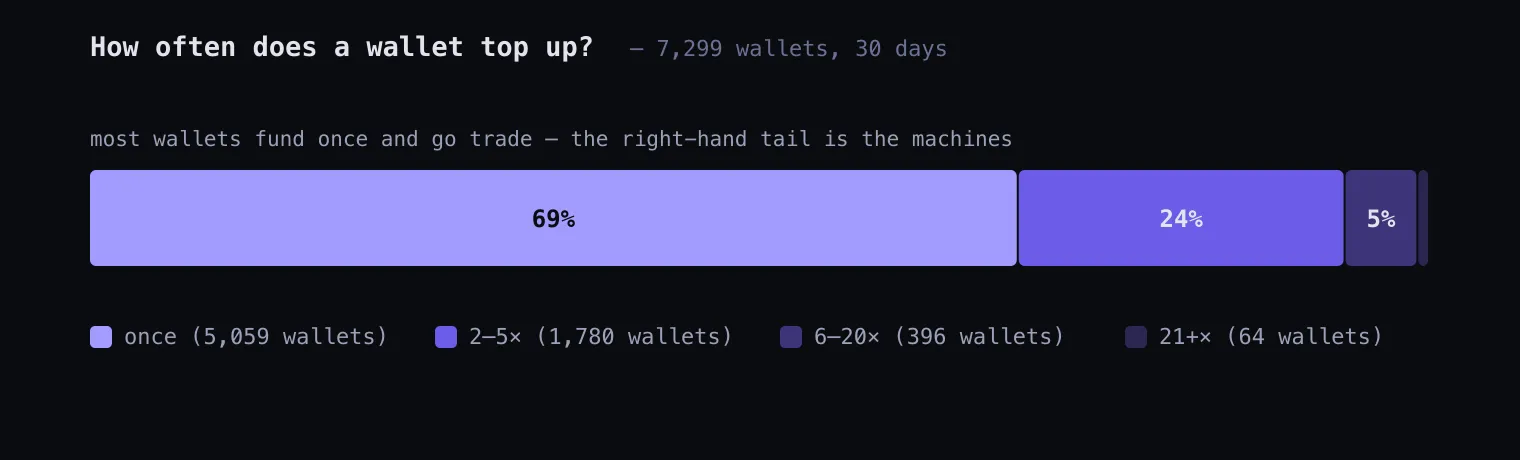
How often does the same wallet top up? Mostly never again — 69% of wallets deposited exactly once in the whole month. Fund, trade, done. The thin right-hand tail — 64 wallets with 21+ deposits — is where the machines live (more on them below).
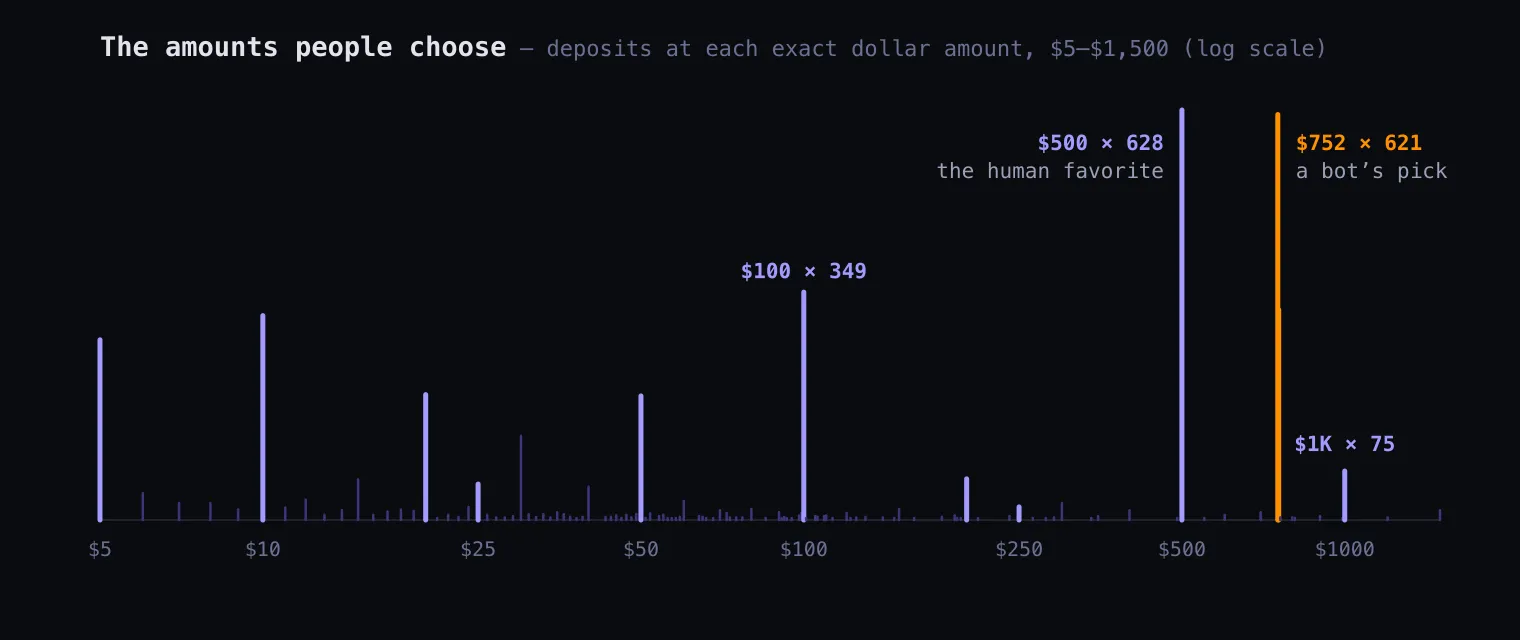
And when humans pick an amount, psychology is visible from orbit. Plot how many deposits landed on each exact dollar amount, and round numbers tower over everything around them — $500 is the crowd favorite (628 deposits), with $100, $10, $20, and $50 close behind. The one tall spike that isn’t round: $752, deposited 621 times — 616 of them into a single wallet. Humans pick round numbers; bots have other favorites.
The top five single deposits of the month — each a real, checkable transaction on Polygon: $783,043 · $676,768 · $550,000 · $500,000 · $499,999. (Whoever sent that last one: we salute the missing dollar.)
The special wallets
Every address below is public on-chain data, and each links to its public Polymarket profile. Standard caveat from our p2p analysis: on-chain data shows structure, not intent — the patterns are unambiguous, the motives are ours to guess.
0x1b47…d814 (@sbsigner) — the metronome: 4,967 deposits in 30 days
This wallet received 4,967 deposits totaling $11.66M — one every ~9 minutes, around the clock, averaging $2,347. No human tops up an account 166 times a day; this is an automated funding pipeline feeding an account whose profile shows 2,466 predictions and a biggest win of $565K. One wallet, nearly a third of the month’s entire attributed deposit volume.
0x37ee…f86f — $5.8M in, and a bio that winks at you
The month’s second-busiest recipient, 0x37ee…f86f, took 4,251 deposits totaling $5.78M. The profile: joined June 2026, only 295 predictions — but $3.0M currently in positions, and a bio that reads, in full: “You should see my other one.” A multi-account operator hiding in plain sight, self-announced. (Our p2p clustering showed how related accounts reveal themselves through transfers; this one skips the analysis and just tells you.)
0xbacd…ab35 (@ScottyNooo) — the one-shot whale: $783K in a single transfer
The largest single deposit of the month belongs to @ScottyNooo: $783,043 of USDC.e in one transaction (plus one more deposit — $200, which is its own kind of funny). This is no anonymous shell: the profile has 210K views, 3,193 predictions, $618K in open positions, and a $677K biggest win. When an account like this reloads three-quarters of a million dollars, that deposit is the signal — capital arriving visibly, before a single order is placed.
0xe907…cff6 (@suntori) — the perpetual-motion machine: 185,668 predictions since June
@suntori appears in this dataset once: a clean $500,000 deposit. What makes the wallet remarkable is everything around it. Joined June 2026; 185,668 predictions since — thousands per day. And in our p2p data, this same wallet is the #1 sender on all of Polymarket: 88,855 outgoing transfers in 30 days, averaging $36 each. Half a million in, an inhuman trading tempo, and a firehose of micro-transfers out — one wallet visible in three different layers of the money flow at once.
0xf705…3ca7 — the quiet giant: $1.9M in profit under a layer of dust
At first glance, 0xf705…3ca7 looks like a junk wallet: 862 of its deposits are dust — $0.21 combined, the address-poisoning spam that plagues every chain. Look past the noise and the picture inverts. Its other 20 deposits total $899,993 — ten of them exactly $60,000, arriving from six rotating sender addresses, like this one. And the account they feed is one of Polymarket’s quiet giants: a fully anonymous profile — no name, no bio — with 2,022 predictions, $552K currently in positions, and $1.88M in all-time profit on $83.7M of lifetime volume (per Polymarket’s public leaderboard data). The dust isn’t the story; it’s a tell — poisoning bots spray the wallets they believe are worth robbing. Under 862 pieces of spam sits an anonymous seven-figure trader reloading $60K at a time.
Why deposits are a signal, not trivia
Here’s the trader’s takeaway: a deposit is intent before action. Money lands in an account because someone plans to deploy it. For the wallets you already care about — the whale you copy-trade, the sharp account whose history you’ve read, the cluster you mapped — a large deposit is frequently the earliest visible event in the chain that ends with the market moving. @ScottyNooo’s $783K arrived before whatever it was for.
Polyflux streams deposit events over the same WebSocket as trades — from the mempool, the moment they happen. Watching a tracked wallet get funded takes the same few lines of Python as watching it trade: filter event_type == "deposit", match wallet_address against your watchlist, and you’ll know the ammunition arrived while everyone else waits to see it spent. Grab a key and put the funding layer on your radar — the trades tell you what’s happening; the deposits tell you what’s about to.