Everything Polyflux streams is public data — you could absolutely build the same feed yourself with a Polygon node and a decoder. The honest question is whether you want a terabyte-scale, hardfork-chasing, protocol-tracking operations job, because that’s what “just run a node” actually turns into. Here’s the full picture, so you can make the build-vs-buy call with open eyes.
Polymarket settles every trade on Polygon, and pending trades sit in the mempool before confirmation. Nothing about seeing them is proprietary. What stands between you and the feed is infrastructure — three layers of it.
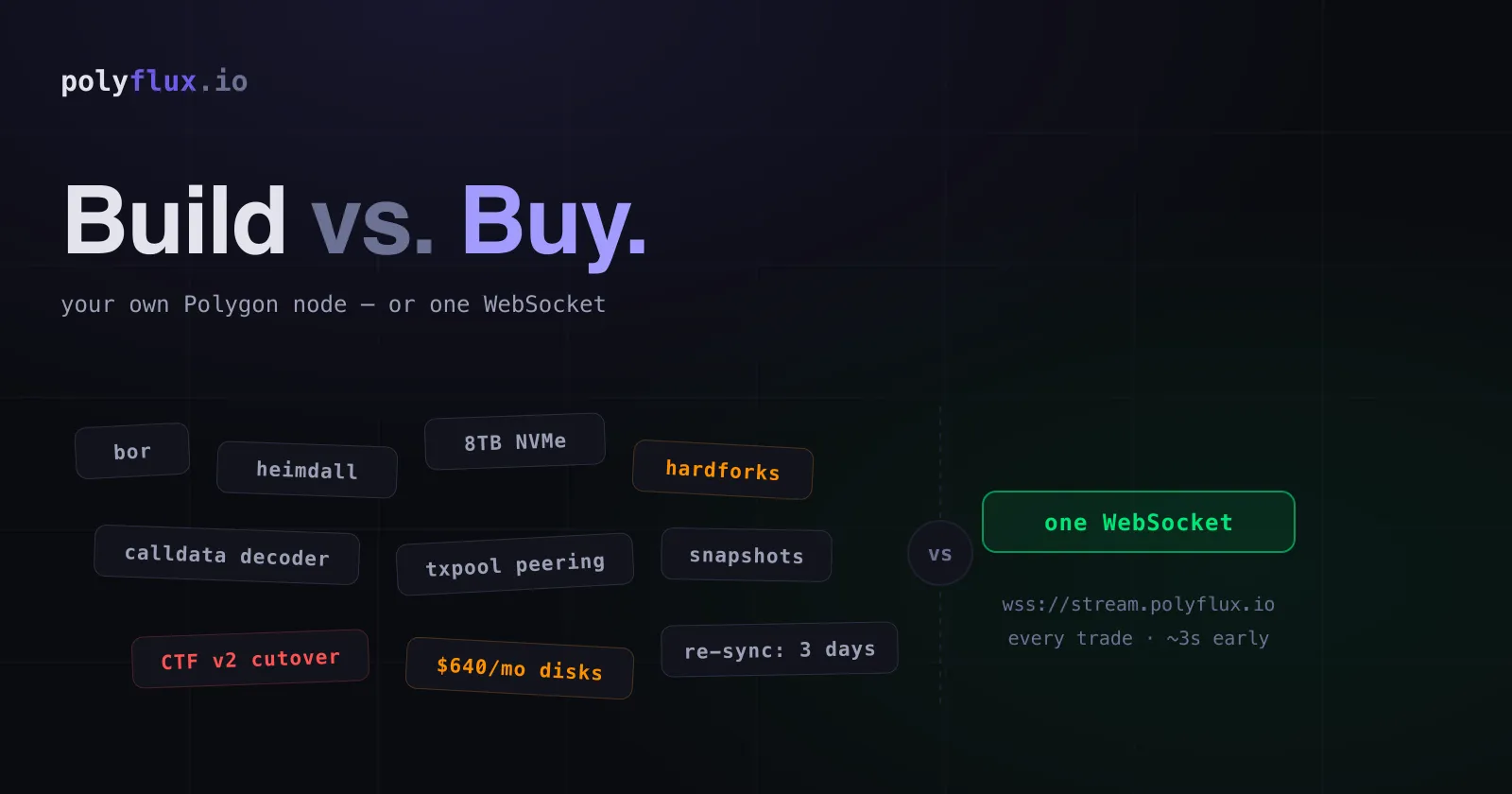
What DIY actually involves
Layer 1: run the node. A Polygon PoS node is two cooperating services — bor (the execution client) and heimdall (consensus). Official minimums start around 1 TB of fast storage, 16 GB RAM, and 4+ cores; realistic RPC-grade setups are recommended at 8 TB NVMe, because the chain grows every day and re-syncing from scratch takes days (snapshot tooling exists precisely because nobody wants to do that twice). This is a real machine with real disks — not a $20 VPS. On AWS, 8 TB of gp3 EBS alone runs ~$640/month before compute. Storage-optimized instances with local NVMe run ~$850–1,050/month for the 7.5 TB class (is4gen.2xlarge, i3en.3xlarge) — and since no instance sells exactly 8 TB, going bigger means the 15 TB tier at ~$1,700+/month. Local NVMe is also ephemeral: stop the instance and the chain data is gone, meaning a multi-day re-sync.
Layer 2: watch the mempool. Confirmed blocks are the easy part. The ~3-second edge lives in pending transactions, which means tuning your txpool, maintaining healthy peering (you only see what your peers relay, as fast as they relay it), and keeping the node responsive under load. Mempool visibility is a quality spectrum, not a checkbox — a poorly-peered node sees trades late or not at all, which defeats the point.
Layer 3: decode Polymarket. What arrives is raw calldata to Polymarket’s exchange contracts. Turning that into “wallet X bought 340 shares of YES at 0.52” means decoding order structs, mapping outcome-token ids to markets, handling negRisk markets’ separate contracts, recognizing splits/merges/redeems, and resolving proxy wallets to meaningful identities. It’s genuinely interesting engineering — the first time.
The part nobody budgets for: the treadmill
Building the stack is a project. Keeping it correct is a job, because both protocols underneath you keep moving.
Polygon ships mandatory hardforks several times a year. Recent history alone: Heimdall v2 (July 2025), the Madhugiri and Giugliano forks (December 2025), a network hardfork in May 2026, and the Chicago fork requiring Bor v2.8.0. Each one is an upgrade-before-the-activation-block deadline. Miss it and your node stalls or follows a dead fork — and for a trading pipeline, a stuck node doesn’t fail loudly. It fails as silence: your bot sees “no trades” and can’t tell that from “no data.”
Polymarket’s protocol evolves too. The clearest recent example: the CTF Exchange V2 cutover in late April 2026 — a breaking upgrade that changed the order struct, exchange contract addresses, collateral handling, and fee model, with V1-signed orders rejected after cutover. Every homegrown decoder watching the old contracts had a hard deadline to re-integrate or silently miss the market’s activity. Before that, negRisk markets introduced an entirely new adapter and exchange to decode. There will be a next one.
Add the routine ops load — disks filling, snapshot refreshes, peer churn, monitoring the monitoring — and the true cost of DIY isn’t the build. It’s the standing commitment.
Latency is maintained, not achieved
One more honest layer: even a perfectly-synced node isn’t automatically a fast node. The mempool edge depends on peering quality, txpool tuning, and staying responsive under bursts — properties that degrade quietly and need re-earning after every infra change. Being early is not a milestone; it’s an SLO. That’s a strange thing to own when what your strategy actually consumes is just the trade events.
”But AI can build all this for me now”
True — and worth taking seriously. A modern AI agent will scaffold the bor/heimdall setup, write the decoder, and wire the WebSocket in a weekend. We’d know; we built a five-minute analysis tool the same way.
But notice what the agent handed you: ownership. The hardfork calendar is now your calendar. The V2-style cutovers are your 2 a.m. deadlines. The disks, the peering, the silent-gap monitoring — yours. Building was never the moat; staying correct while two protocols move underneath you is. A service amortizes that treadmill across all its customers; DIY makes you the sole customer of your own ops team.
The realistic comparison isn’t “weekend of AI-assisted setup” vs. “pip install”. It’s “permanent part-time infrastructure job” vs. one WebSocket that’s already correct — maintained through every fork and cutover by people whose entire product is that correctness.
When DIY genuinely wins
To be fair, running your own node is the right call when:
- you need arbitrary on-chain data beyond Polymarket (custom contracts, other protocols, archival queries);
- sovereignty is a hard requirement — no third-party dependency is acceptable;
- you already operate blockchain infra and the marginal cost is near zero.
If none of those describe you — if what you want is every Polymarket trade, the millisecond it happens — the build-vs-buy math is short. Grab a key, pip install the client, and spend the weekend on your strategy instead of your disks.