The strategy is to be the other side of the panic: keep resting buy orders below the market in a few markets you genuinely understand, and when a forced seller sweeps the book, your bids collect the discount. It worked against the wallet we profiled last time to the tune of about $62K — money that went to whoever had bids resting when he blinked. This post covers the concept, the risk that pays for it, and the execution.
The concept: someone has to sell right now
Every panic sell is a trade of price for speed. A seller who must exit immediately — fear, margin elsewhere, a decision made in anger — does not wait for a fair counterparty. He takes every bid on the book, from best to worst, until his position is gone. On thin prediction-market books, that gets expensive fast.
Here is what that looked like on July 30, drawn from real data. The market’s price barely moved — but the sweep filled 172,393 shares at prices down to $0.51, straight through where any resting bids would have been sitting:
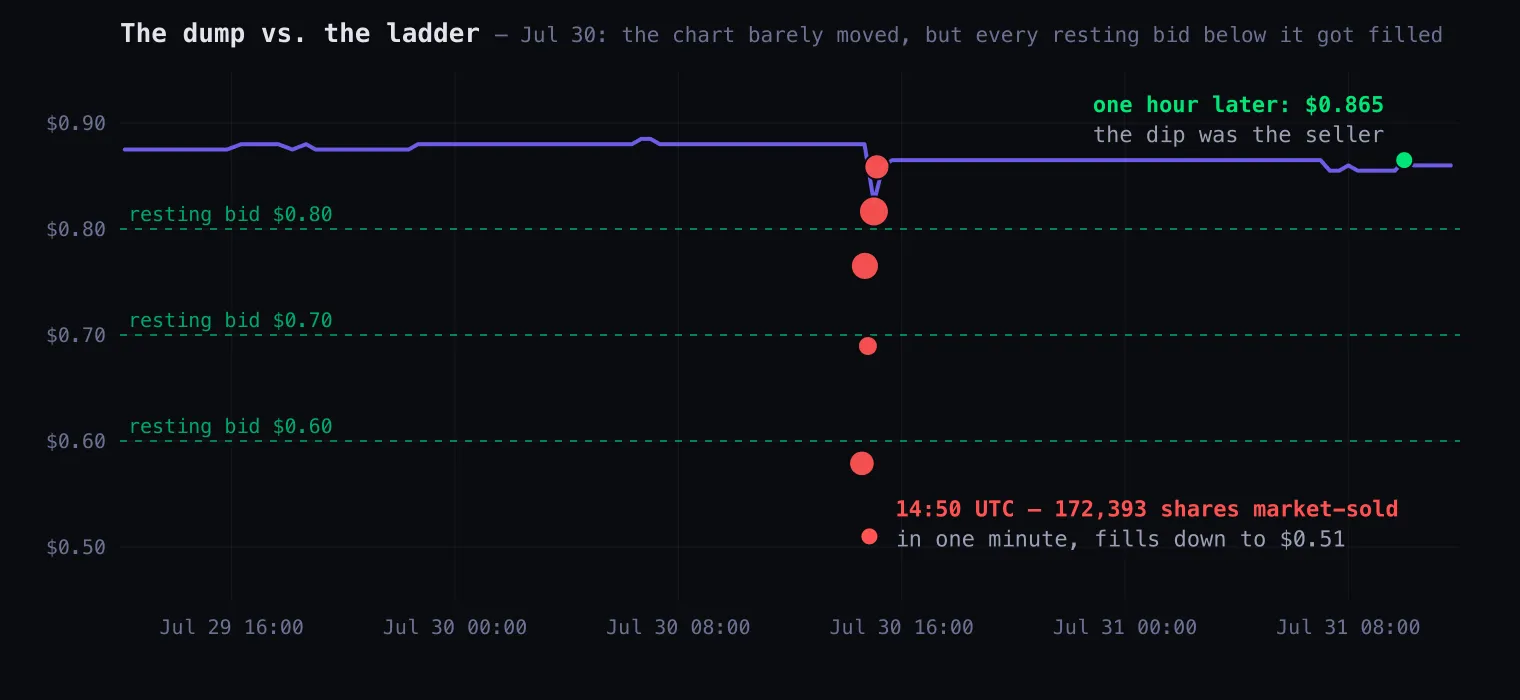
Whoever owned those bids bought $0.88-shares at $0.80, $0.70, $0.60. Not because they predicted anything — because they were there, and someone needed them to be.
You are not predicting the news. You are selling immediacy to people who suddenly cannot live without it.
This is not hypothetical — meet the other side
We have watched one wallet run exactly this strategy for months: Gohst. His limit orders rest 20, 40, even 60 cents below the current price, across a large set of markets at once. When a liquidity sweep happens, he is the one buying. At those depths a single fill can return a multiple of what he paid — which is why the strategy survives its losers. Does every trade win? Obviously not. But statistically he is firmly positive: per Polymarket’s public leaderboard data, $328K in all-time profit on $1.97M of lifetime volume — and his profit curve is the mirror image of smallpig’s cliff: a steady, patient climb.
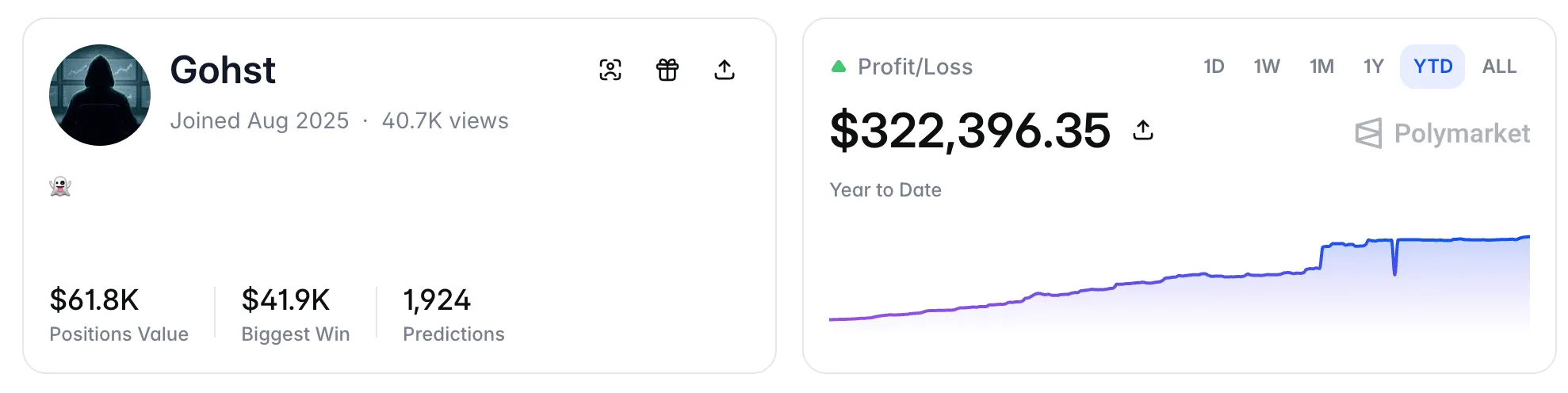
Two things stand out in how he runs it:
- Market selection. His positions cluster in politics, geopolitics, and celebrity markets — and notably not in crypto or sports. That choice is deliberate, and the next section explains why.
- Capital discipline. Resting orders lock up balance. Even $30 across 100 markets is $3,000 committed before anything fills — and Gohst keeps over $60K working in open positions at any given time, sized per market by type. The ladder is cheap to describe and expensive to hold; the budget is the strategy.
The risk that pays for it: adverse selection
Before the mechanics, the honest part. When your bid at $0.60 fills during a crash, there are two possibilities: you just bought from someone panicking about nothing — or you just bought from someone who knows something you don’t. The second case is called adverse selection, and it is the rent this strategy pays. If China had actually mobilized that morning, the $0.51 fills would have been the seller’s best trade, not the buyer’s.
You cannot eliminate that risk. You can manage it:
- Pick markets where news is slow and public. A long-dated tail-risk market (“invasion by end-2027”) moves on headlines everyone sees. Private-information markets — court rulings, earnings, insider-prone questions — are where filled bids are most often informed flow. This is exactly why Gohst avoids crypto and sports: prices there genuinely collapse all the time, so a deep fill is far more likely to be an informed one.
- Size so that being wrong is survivable. A ladder that would put 2% of your bankroll into one market if fully filled is a strategy; one that puts 40% in is a prayer.
- Stay away from resolution windows. Near a market’s end date, and especially during proposals and disputes, price moves carry much more information. The noise-to-news ratio is worst exactly when resolution machinery is running.
- Check what actually happened before re-quoting. After a fill, thirty seconds of reading beats reflexively re-arming the ladder into a real event.
The passive half: the ladder
The placement itself is simple. In each chosen market:
- Decide the maximum position you are willing to hold if everything fills.
- Split it across a few price levels below the midpoint — for example 5%, 15%, and 30% below — with more size at deeper levels, where fills are rarer but discounts larger.
- Leave the orders resting. Cancel and re-place as the midpoint drifts, and after any fill, re-assess before re-arming.
Depth placement is a trade-off you tune per market: shallow bids fill often for small edges; deep bids fill rarely, but when they do, it is against exactly the kind of sweep from the chart above. The July 30 seller went through $0.80, $0.70, and $0.60 in the same minute.
Execution: watching hundreds of markets at once
Here is where execution decides whether the strategy is even possible. A ladder in five markets is easy to babysit. Gohst’s version needs eyes on hundreds — every market where his orders rest. The standard approach is Polymarket’s market-data websocket, subscribed market by market; fine for a handful, genuinely painful at hundreds or thousands of subscriptions. This is where blockchain-level access comes in: one stream carries every trade on the platform, so watching a thousand markets costs the same as watching one.
The point is not fast reactions — and during a sweep itself, there are none to be had. A falling knife is over immediately; no feed makes anyone fast enough to step in front of it, ours included. The stream’s job is before and after: create, adjust, and delete resting orders as markets drift during normal activity, and see what filled once something happens. The only ongoing work is repositioning — re-centering the ladder under a drifted price, or pulling orders from a market that no longer qualifies.
# pip install polyflux-client
import asyncio
from polyflux import Client

MY_MARKETS = {"1234…", "5678…"}   # asset_ids where your orders rest

async def main():
    client = Client("YOUR_API_KEY")
    async for trade in client.trades():
        if trade.asset_id in MY_MARKETS:
            side = "buy" if trade.is_buy else "sell"
            print(f"{trade.asset_id}: {side} {trade.size:,.0f} @ {trade.price:.3f}")

asyncio.run(main())
That is the whole interface: one connection, every trade, filtered down to the markets you care about. On top of it sits the actual work — the logic that creates, updates, and deletes your resting orders as markets drift, and records what filled.
After the fill: two outcomes, one decision
Once the shares are yours, there are only two cases. Either it was a liquidity sweep — the market restores, and you now hold shares bought far below a price that came back — or the price collapsed for a real reason, and you bought exactly what the seller was right to flee. What to do next is a strategy choice: some traders sell the recovery within hours; some cut the losers once the news is confirmed.
Gohst’s answer is the simplest possible one: he sits and waits until the market ends naturally. No exit trades, no re-timing — hold every fill to resolution and let the $1-or-$0 settlement do the accounting. Priced at 20–60 cents below market, enough of his fills resolve in his favor that the patience pays for the occasional zero. It is not the only valid answer, but it is the one that requires no further decisions — and for him it has worked.
And here this article meets the previous one. Gohst’s largest open position today is NO in the same “China x Japan military clash” market that smallpig kept panic-selling: 9,056 shares at an average entry of $0.39, now marked at $0.92. He holds the Taiwan-invasion NO too — average $0.46, now $0.87. Now the remarkable part: those markets have never traded at those prices. The Japan market’s all-time low on the daily chart is $0.835. An average entry of $0.39 cannot come from buying dips on the chart — it can only come from resting bids filled inside sweeps, in the seconds nobody else could react to. That is this entire strategy, visible in one public position readout.
After the dust: read the tape
Every cascade deserves an autopsy, win or lose. Trades Inspector replays it in two clicks — paste the market, select the dump’s minutes, and see every wallet involved: the seller, the bids that caught each fill, and at what discount. We showed that exact workflow in the previous post on the July 30 dump. Doing this after each event teaches you the local ecology fast: which markets have real resting depth, who the other patient buyers are, and how quickly prices actually recover.
What this strategy is, and is not
It is: selling liquidity at prices you chose in advance, in markets you understand, with risk you sized deliberately — plus an information edge about when it is happening. It is not: free money, a guarantee, or a reason to catch every falling knife on the platform. Some knives are falling for a reason; the discipline is in the market selection and the sizing, and the discount is your payment for carrying the risk that this time, the seller was right.
If you want the tripwire side of it: grab a key, run the few lines above, and watch the flow of trades across every market from one connection — seeing a real sweep go through the tape is what makes the whole concept click.